
NGOC LINH / DETAILED CURRICULUM
Session 3, 4, 5: Imagine
Materials: Sticky notes, pens, pencils, and presentation.
First, students are introduced to the activity’s principles: encourage all wild ideas, as absurd as possible. Every idea mattered. Next, they are divided into four teams of 12 to participate in the warm-up activity.

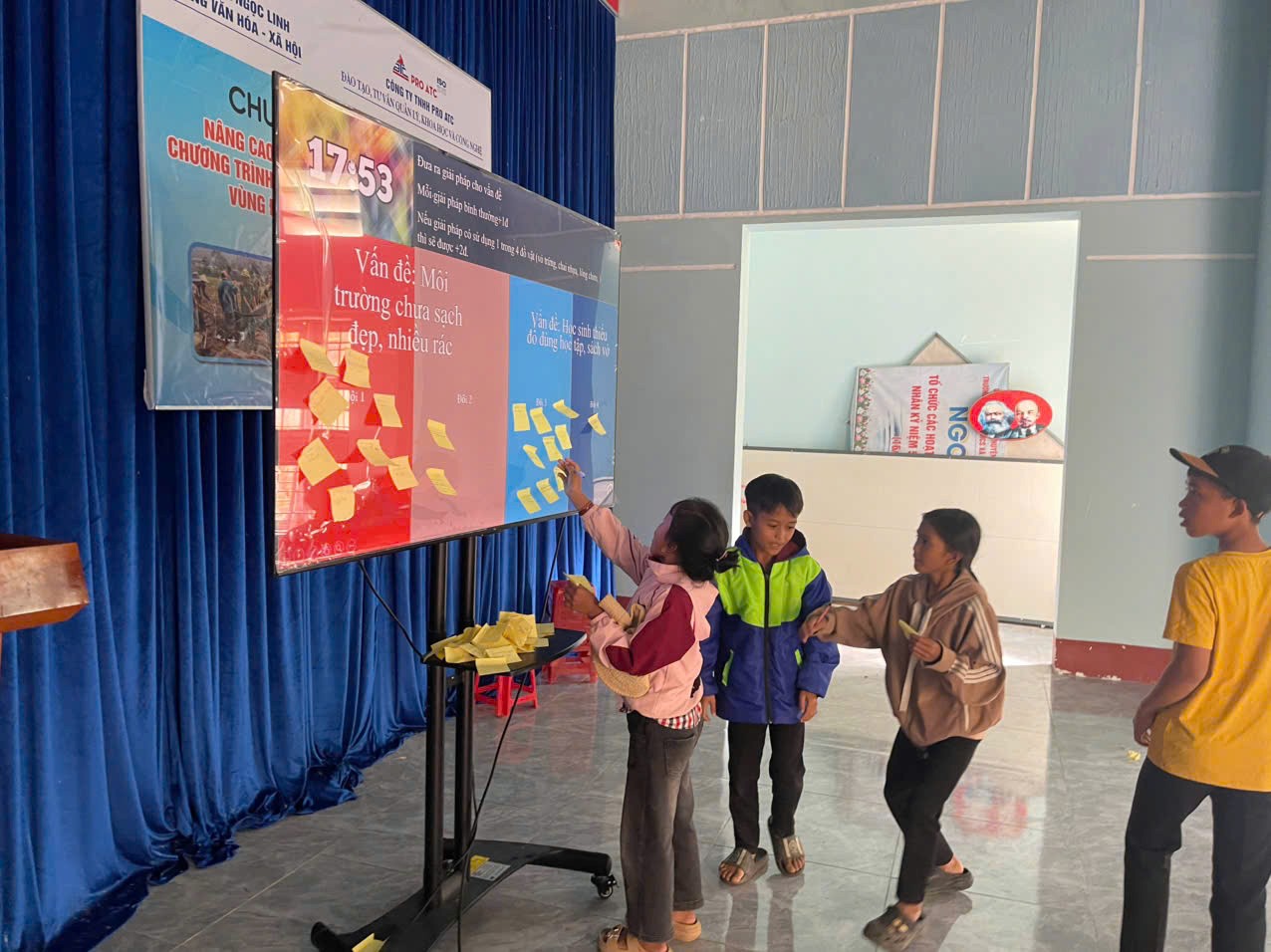
In teams of 12, within 10 minutes, students must list as many uses as possible for their assigned materials. Students write their ideas down on sticky notes, then move towards the boxes on the screen and stick them on. The four materials are: eggshells, coffee grounds, plastic water bottles, and car tires.
Warm-up

Exploring uses for everyday materials.
Main activity 1
Within 15 minutes, students provide a solution for the two most common problems they have proposed in their previous session: an unclean school environment and a lack of school supplies. The way to present their ideas is similar to the previous activity: using sticky notes. A small twist: if the solution includes any of the four materials in the warm-up activity, they would get twice the points.

Ideas for a cleaner school and more school supplies.

Objectives
Students could answer the question: "How could we implement our ideas?" correctly. This would also allow me to pinpoint the capabilities of the students so I could move on into helping them to plan the solutions.
Objectives
Students would be confident in raising their original ideas for the first time, using materials picked up from their daily life for familiarity and reduced difficulty. From this, students could evolve their premature original ideas into the answer to a broader question: how can we utilize things familiar to us to solve the problems that we care about? Overall, this instills in them a belief that they can think of the bridge connecting the problems worries them to the outcome, and also allows them to explore their original ideas that they hadn’t seen before.
Main activity 2
Materials: Hint sheet, blank paper, pens, paper, filling answer sheet, presentation.
This week, students thought more deeply about how to implement the solutions that they devised the previous week. Students sat in the groups from the previous session. Then, each group is given two blank A3 sheets of paper and a prompt sheet. On the prompt sheet, there are three columns. Column 1 and Column 3 respectively detailed all the recyclable materials and school supplies that they proposed the previous week. Column 2 includes the verbs related to creating, crafting. Students need to connect words from three columns to create a sentence with the structure [recycleable materials] + [verb]+ [school supplies] that would be filled in the sheet.
Ideas for a cleaner school and more school supplies.
Post-session notes
I was correct that increasing the interaction between students and the lesson would boost their engagement. However, at the beginning, they had some problems defining “uses” and “solutions”. So, I did the same as in the previous session: I sat down and helped them visualize these abstract terms through concrete examples: “You can make pencil cases by recycling old carton boxes or water bottles. This would reduce the waste in the school, so it is one solution to our unclean environment. This also creates new school supplies for us, so it is a solution to our scarcity.”
During the warm-up game, many students were still shy to voice their opinions, so each group only gave about 10-15 valid ideas. Nevertheless, after I sat down to help them clarify and orient their thinking, their eyes immediately lit up with new ideas. In the second round, they were much more enthusiastic. Seeing the screen flooded with yellow sticky notes, my heart was also overwhelmed with excitement and happiness. In the end, I recorded about 40-50 ideas from each group, of which half are valid. Many wrote down absurd ideas that even I hadn’t thought of before: organic face masks from coffee grounds, lanterns from eggshells,…
After the fifth session, I witness an even more promising progress: students start asking me for Math and English help with their work. I saw how powerful it is when we finally allow these chilren to think original ideas beyond the textbook.